
Something Happened to APC in August 2025 — Google Trends Knows It
The data speaks first
I was reviewing Google Trends data for the terms I work with every day — advanced process control, soft sensor, virtual sensor, predictive control, digital twin, Kalman filter — when I noticed something unusual.
For roughly twenty years — from 2004 to mid-2025 — these terms were essentially flat. A few engineers searching, a few academics, a predictable hum of niche interest. Then, in a single month, the pattern broke.
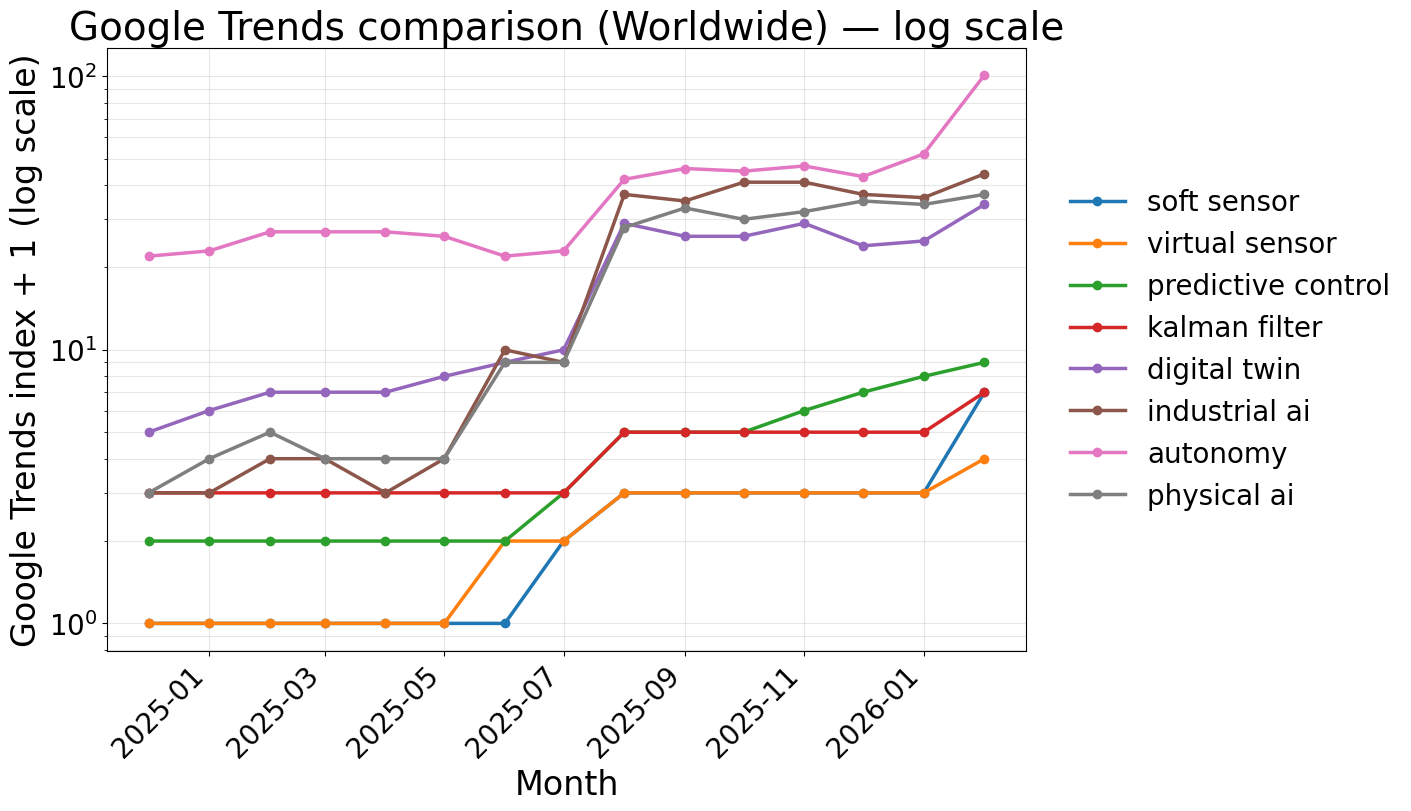
Google Trends, worldwide, log scale. All values normalized 0–100 relative to peak. The vertical axis is logarithmic — a jump from 1 to 6 is the same visual distance as a jump from 6 to 36.
The raw numbers from the Trends export:
| Term | May 2025 | Jun 2025 | Jul 2025 | Aug 2025 | Change Jun→Aug |
|---|---|---|---|---|---|
| digital twin | 20 | 24 | 26 | 84 | +3.5× |
| predictive control | 3 | 4 | 5 | 13 | +3.3× |
| Kalman filter | 6 | 6 | 6 | 12 | +2× |
| soft sensor | 1 | 1 | 2 | 6 | +6× |
| virtual sensor | 1 | 2 | 2 | 7 | +3.5× |
| advanced process control | 1 | 1 | 1 | 6 | +6× |
And this was not a spike that reversed. By February 2026, predictive control reached a new all-time high on the index. Digital twin stayed elevated for seven consecutive months. Something structural changed.
One caveat before going further: Google Trends shows relative search volume, normalized to 100 at the peak. It does not report absolute query counts. A term doubling from 500 to 1,000 searches looks the same as one doubling from 50,000 to 100,000. What makes this data notable is the synchronization — multiple independent, technically specific terms all moving together in the same month. That points to a systemic cause.
Twenty years flat. Then a cliff.
Before drawing conclusions, the historical context matters.
Predictive control was already being searched in 2004. Digital twin had been growing slowly since 2017. Kalman filter has been a stable niche term for decades. These are not new concepts that went viral. They are mature engineering disciplines with established, largely static audiences.
For all of them to jump simultaneously, in the same month, is unusual enough to warrant explanation. My reading is that the physical AI wave of 2025 pulled the industrial control stack — for the first time — out of specialist obscurity and into mainstream engineering conversation.
My interpretation: APC-adjacent terms rose primarily as a second-order effect of a much larger public shift around physical AI, autonomous operations, and digital twins. The classic control vocabulary was carried upward by a broader narrative. The rise in the umbrella terms (digital twin, industrial AI, autonomy) came first; the rise in the technical enabling methods (predictive control, soft sensor, Kalman filter) followed.
That said, this is an interpretation from timing and public announcements, not proof of searcher intent.
The timeline: January to August 2025
The August jump did not happen overnight. Tracing the public record from the start of 2025 reveals a four-stage build-up.
January–March: the priming
Two events reset expectations in January.
On January 6, Jensen Huang used CES to unveil NVIDIA Cosmos — a world foundation model trained on 20 million hours of video of physical systems — and declared: “Physical AI will revolutionise the $50 trillion manufacturing and logistics industries.” Physical AI was no longer a research category. It was a product roadmap.
Two weeks later, DeepSeek R1 dropped. Its real effect on industrial AI was this: it broke the assumption that advanced AI required expensive cloud infrastructure. Process engineers who had been told that AI integration required Azure subscriptions and GPU clusters suddenly asked: can this run on an industrial edge gateway?
At GTC 2025 in March, NVIDIA put industrial digital twins at the center of its keynote: Omniverse blueprints for AI factory design, Isaac GR00T N1 for humanoid robots, and the Newton physics engine co-developed with Google DeepMind and Disney Research. Foxconn, BMW, TSMC, and Toyota were all shown building factory-scale digital twins. Schneider Electric and ETAP launched a physics-based power-infrastructure digital twin at the conference.
The message reaching process industry engineers watching from a distance: your industry’s simulation methodology has just been adopted by the consumer electronics world at scale.
May: physical AI becomes a product category
May 18 — NVIDIA’s COMPUTEX keynote introduced Isaac GR00T N1.5 and GR00T-Dreams, a pipeline that generates robot training data from simulated “dream” sequences rather than physical demonstrations. Engineers who work with soft sensors immediately recognized the parallel: synthetic process data generation for model training is the same concept applied to process models for decades.
May 19/21 — Microsoft announced Digital Twin Builder in Fabric Real-Time Intelligence — a low-code/no-code tool for building digital twins, included in existing Fabric subscriptions. The audience was not simulation specialists; it was operations analysts and data engineers who already had Azure and suddenly had a direct path to operational digital twins. When that kind of tool ships, umbrella terms grow before the deeper technical terms follow.
June: autonomy enters industrial operations
This is the month the narrative became explicitly relevant to process control.
Financial context was also crystallizing: market analysts published projections in June 2025 placing the global APC sector at $10.3 billion by 2034, driven explicitly by AI and IoT integration. A headline like that draws non-specialist attention — procurement teams, investors, management consultants — who then search the underlying vocabulary.
June 3 — Yokogawa launched the next generation of CENTUM VP and framed it explicitly around sustainable autonomous operations, describing the industry transition from automation to autonomy.
June 9 — At its annual Users Group in San Antonio, Honeywell launched its new AI portfolio under the banner “From Automation to Autonomy” — the phrase that headlined their press release and framed the entire product announcement. The conference program placed Advanced Process Control, Process Digital Twin, and AI/Autonomous Operations in the same track — unusual in previous years. Honeywell launched its AI-Enabled Digital Suite and Digital Cognition: AI agents running process digital twins to provide real-time operational guidance. The Autonomous Operations Assistant was positioned as software running on behalf of each console operator.
The Honeywell Users Group reaches tens of thousands of process engineers across refining, chemicals, and LNG. Putting APC and autonomous operations in the same conversation drove searches from Honeywell’s installed base asking what the technical foundation of “autonomy” actually looks like.
June 11 — NVIDIA published its Germany industrial AI push, tying together AI factories, manufacturing, robotics, and physical AI for the European engineering audience.
June 18 — Yokogawa and Shell announced a formal agreement for AI-vision robots in autonomous plant maintenance. The critical detail: when robot-acquired sensor data connected back to the plant control system, it would issue instructions back to the control loop — exactly the interface between virtual sensing and process control that APC engineers had been discussing theoretically for years, now deployed by a major oil company in collaboration with a major DCS vendor.
July: the direct APC connection
July 22 — Emerson’s AspenTech business and TotalEnergies announced a global strategic collaboration covering three specific technologies: Aspen Inmation (industrial data fabric) across all TotalEnergies sites worldwide, Aspen DMC3 (model predictive control) across Exploration & Production operations, and Aspen GDOT (closed-loop real-time optimizer) across multiple refinery sites.
TotalEnergies is one of the world’s largest integrated energy companies. A formal commitment to company-wide MPC deployment — naming the specific products — is not routine news. It immediately prompted searches from engineers at competitor companies, from DCS vendors’ customer teams, and from anyone trying to understand what architecture TotalEnergies was building and why.
This announcement lines up closely with the pre-August uptick in predictive control and advanced process control visible in the data.
Also in July — At the other end of the spectrum, Trend Micro launched a cybersecurity model built around digital twin capabilities for simulating threats. This broadened the audience for “digital twin” searches beyond process engineers, contributing to the term’s continued rise before the August peak.
August: the breakout
Three events converged in August.
August 6 — Imubit published “APC Meets AI”, an article explicitly reframing advanced process control through the lens of AI. This is notable because it came from a specialist APC vendor, not a general tech outlet — signaling that the APC industry itself was beginning to re-language its work in AI terms accessible to a broader audience.
August 8 — NVIDIA published “Physical AI Accelerated by Three NVIDIA Computers for Robot Training, Simulation and Inference”, explicitly stating that physical AI is experiencing its breakthrough moment and describing the training-simulation-inference stack for autonomous physical systems. This post was widely shared in engineering communities.
August 11 — At SIGGRAPH 2025, NVIDIA unveiled Cosmos Reason (a physics-understanding vision language model), NuRec (3D Gaussian splatting for large-scale site reconstruction from sensor data), and Isaac Sim 5.0 (open-sourced). The NuRec announcement was particularly relevant for process industries: converting lidar and camera scans of plant sites into live 3D models connected to process data is precisely the pipeline that feeds operational process digital twins.
August 12 — Ansys and NVIDIA announced that Ansys Fluent — the dominant CFD tool in process industries — would embed NVIDIA Omniverse directly. Engineers who model reactor flows, heat exchanger dynamics, and combustion processes in Fluent gained a direct path from their simulation models to operational digital twins.
August 25 — NVIDIA launched Jetson AGX Thor (Blackwell-class edge AI, 2,070 FP4 teraflops at $3,499) with Caterpillar and Hexagon among early adopters. Real-time soft-sensor inference on field-deployed hardware became economically credible.
By late August, physical AI, digital twins, simulation, and industrial AI infrastructure were no longer parallel stories. They had converged into one coherent narrative that engineers, operations teams, and management could all recognize simultaneously.
Why each term moved
The causal chain differs slightly for each term:
Digital twin caught the largest wave because it was named explicitly in nearly every announcement — Honeywell, Microsoft, NVIDIA, Ansys, Yokogawa, TotalEnergies. By August, multiple independent storylines were converging on the same word.
Advanced process control / predictive control spiked most directly on the TotalEnergies/AspenTech announcement. A company of that scale naming specific MPC products in a press release prompted searches from peer companies’ engineering and procurement teams.
Soft sensor / virtual sensor rose as a second-order effect. Large-scale MPC requires continuous estimates of unmeasured process quality variables — exactly what soft sensors deliver. When engineers research DMC3, they find soft sensors. When they read about Yokogawa’s autonomous plant maintenance using AI vision, they recognize it as virtual sensing. The Kalman filter and state estimation thread runs through all of it.
Kalman filter saw a smaller but real increase, driven by two mechanisms: the state estimation algorithms underlying NVIDIA’s robotics platforms (sensor fusion in Isaac uses Extended and Unscented Kalman Filters), and a research wave in hybrid neural-Kalman architectures for autonomous vehicles generating significant press coverage in mid-2025.
An alternative hypothesis worth noting
One explanation I have not seen clearly dismissed: Google’s expansion of AI Mode search in mid-2025. As Google rolled out AI-powered deep search capabilities through Search Labs, engineers exploring complex topics via conversational AI queries may have generated technical search strings — including “predictive control,” “Kalman filter,” “soft sensor” — that would not have appeared in traditional search logs. If AI Mode expansion coincided with August 2025, a portion of the Trends jump may reflect a change in how people search rather than (or in addition to) what they are searching for. I cannot confirm the exact timing of the rollout, but it is a plausible contributing factor worth investigating.
What I think is actually happening
The broader pattern here resembles what happened with cloud computing around 2010–2012 and with machine learning around 2015–2017. In each case, techniques that had been applied quietly in niche industries for years were repackaged and adopted at scale by adjacent industries — and the resulting visibility pulled the original specialist searches up along with it.
The process industry has been running model-based control, state estimation, soft sensing, and real-time optimization since the 1980s. Refineries with full MPC coverage, soft sensors inferring polymer quality, Kalman filters estimating reactor concentrations — none of this is new.
What is new is that the physical AI wave has put exactly this stack — model, state estimator, optimizer — at the center of mainstream engineering discourse. Jensen Huang’s “training computer, simulation computer, physical AI computer” framing is structurally identical to what APC engineers call the model, state estimator, controller architecture. The vocabulary is different; the underlying structure is the same.
The sustained elevation through late 2025 and into 2026 suggests this is not a temporary hype spike. The predictive control index reaching its all-time high in February 2026 — six months after the August jump — points to something structural: a larger engineering audience that discovered the field and has not gone away.
Whether that translates to actual project investment is a separate question. But the discovery is real.
One institutional signal supports the structural thesis: in September 2025, the World Economic Forum published Physical AI: Powering the New Age of Industrial Operations with Boston Consulting Group, formally codifying “Physical AI” as the convergence layer between digital intelligence and physical autonomy. Documents at this level propagate through executive briefings and investment theses — translating engineer-level interest into boardroom vocabulary. The sustained APC-adjacent search elevation through late 2025 likely reflects, in part, this second wave of propagation.
What do you think?
I’m genuinely curious whether this matches what you’re observing on your side.
Have you received more RFPs or inquiries mentioning digital twin, autonomous operations, or physical AI since mid-2025? Did you have the experience of being asked to explain what your MPC or soft-sensor work has to do with what was announced at GTC or Honeywell Users Group? Are clients framing requests differently than they would have two years ago?
I’m also interested in other explanations. The TotalEnergies/AspenTech announcement lines up well with the predictive control uptick, but it may not be the main driver for other terms. And the August NVIDIA cluster is the strongest public signal, but some of the actual searching may have been driven by events I haven’t found — internal mandates, vendor roadshows, a LinkedIn thread that spread, a specific paper.
I read every message and reply to those that add something to my understanding. If enough people share observations worth synthesizing, I’ll write a follow-up.
Read next
If this article prompted questions about how predictive control, soft sensors, or state estimation actually work in practice, the design patterns section covers the underlying methodologies:
Structured breakdowns of model predictive control, Kalman filtering, soft-sensor design, and real-time optimization — the technical stack behind the search trends above.
Dr. Rafał Noga is an independent consultant specializing in advanced process control, soft sensors / virtual sensors, and state estimation for industrial processes. He works across chemicals, pharma, energy, and aeronautical applications.
Have a project or a question?
Contact Dr. Noga →