
A subsystem works, but the whole strategy feels brittle
Local loops may be acceptable while mode transitions, supervisory logic, or operating priorities still create weak overall behaviour.
Information according to § 5 TMG (German Telemedia Act):
Dr. Rafał Noga
Waldstr. 3
94149 Kößlarn
Germany
Contact
Phone: +49 175 617 6792
E-mail:
VAT ID (§ 27a UStG)
DE457893621
Academic title
Dr. (doctorate awarded in Spain)
Responsible for content according to § 55 Abs. 2 RStV: Dr. Rafał Noga (address as above).
This site uses no cookies, no external fonts and no tracking. The server keeps only technical logs (IP, timestamp, requested file) necessary to operate, purged regularly. If you contact me by e-mail or phone, your data will be processed only to answer your inquiry.
Data controller
Dr. Rafał Noga
Waldstr. 3, 94149 Kößlarn, Germany
E-mail:
Support for teams working on utility-scale wind turbine control, diagnostics, and control architecture when conventional tuning is no longer enough.
Discuss a wind control problemMulti-MW wind control background · diagnostics · forecasting and MPC concepts
Supervisory control
Wind programmes often have acceptable local controllers and still weak overall behaviour because transitions, priorities, diagnostics, and upper-layer decisions do not fit together cleanly.
That is where an outside review helps most: not by retuning one block in isolation, but by clarifying how forecasting, diagnostics, mode logic, and higher-level control ideas should influence the operating strategy.
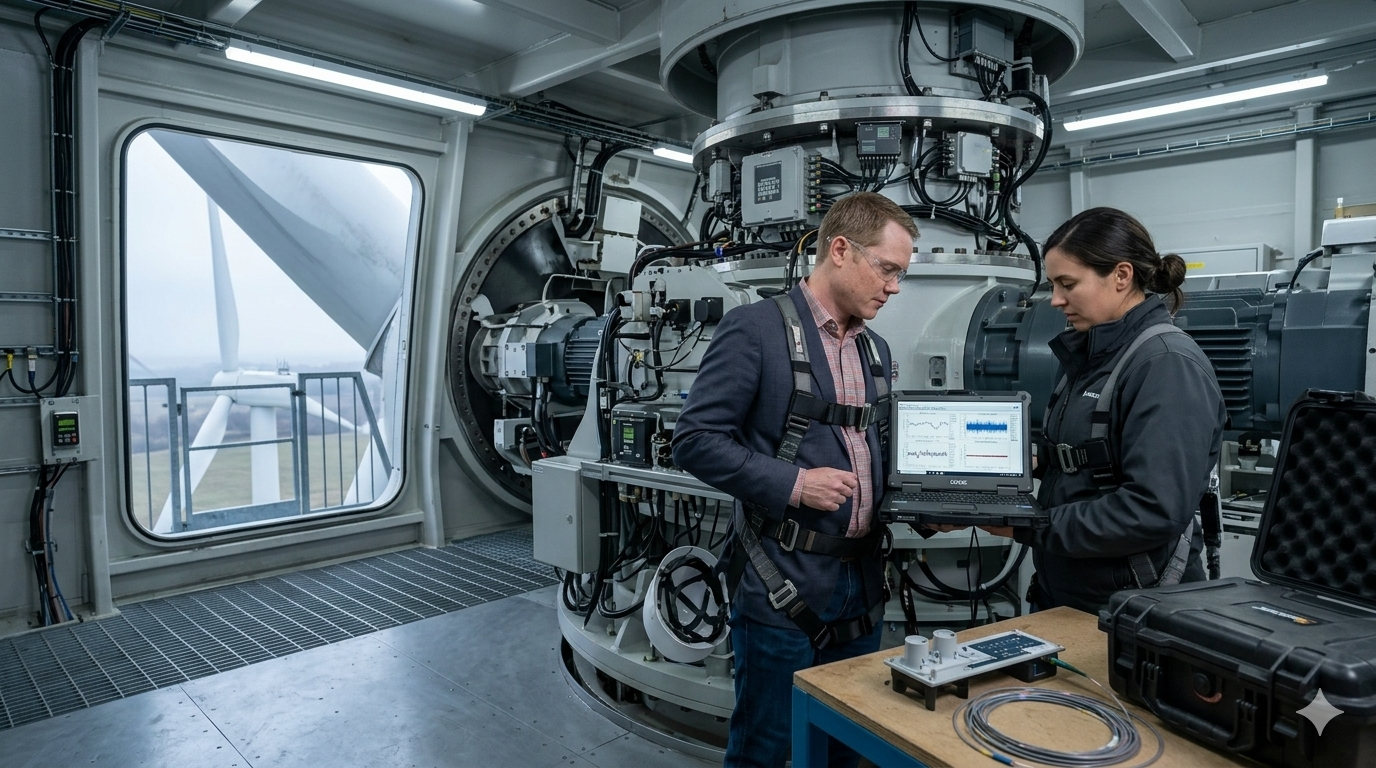
Review supervisory logic, operating modes, transitions, and the boundaries between embedded control loops and higher-level decision layers.
Assess whether current logic balances energy capture, load handling, fault response, and lifetime-oriented operation in a technically coherent way.
Clarify whether fault detection, filtered signals, and derived indicators are good enough to support robust operation and decision-making.
When wind prediction, MPC ideas, or digital models are already in play, help define whether they are actually improving the stack or just adding complexity.
A fixed-scope, fully remote review of the control architecture, operating data, diagnostics, and model assumptions. Five working days, delivered over 1–2 weeks, for €4,500 fixed.
You receive a 1-page executive summary, a detailed technical report, optional analysis scripts and raw figures, and a 60-minute Q&A call.
If implementation support is useful after the diagnostic, continue with an Advisory Retainer from €4,500/month (5 days at €900/day, month-to-month).
Local loops may be acceptable while mode transitions, supervisory logic, or operating priorities still create weak overall behaviour.
The project has models, signals, and forecasts available, but it is not obvious how they should shape the real control architecture.
An external technical review can reduce bias around entrenched design assumptions and help the team decide what to change first.
A short call can determine whether the issue is mostly architecture, control logic, diagnostics, or a deeper modelling problem.
Book a 30-min technical fit call →